

When a College Dilutes Its Identity: The Cautionary Tale of Hampshire College
A story about what happens when a bold brand gets watered down — and what it takes to bring it back to life.
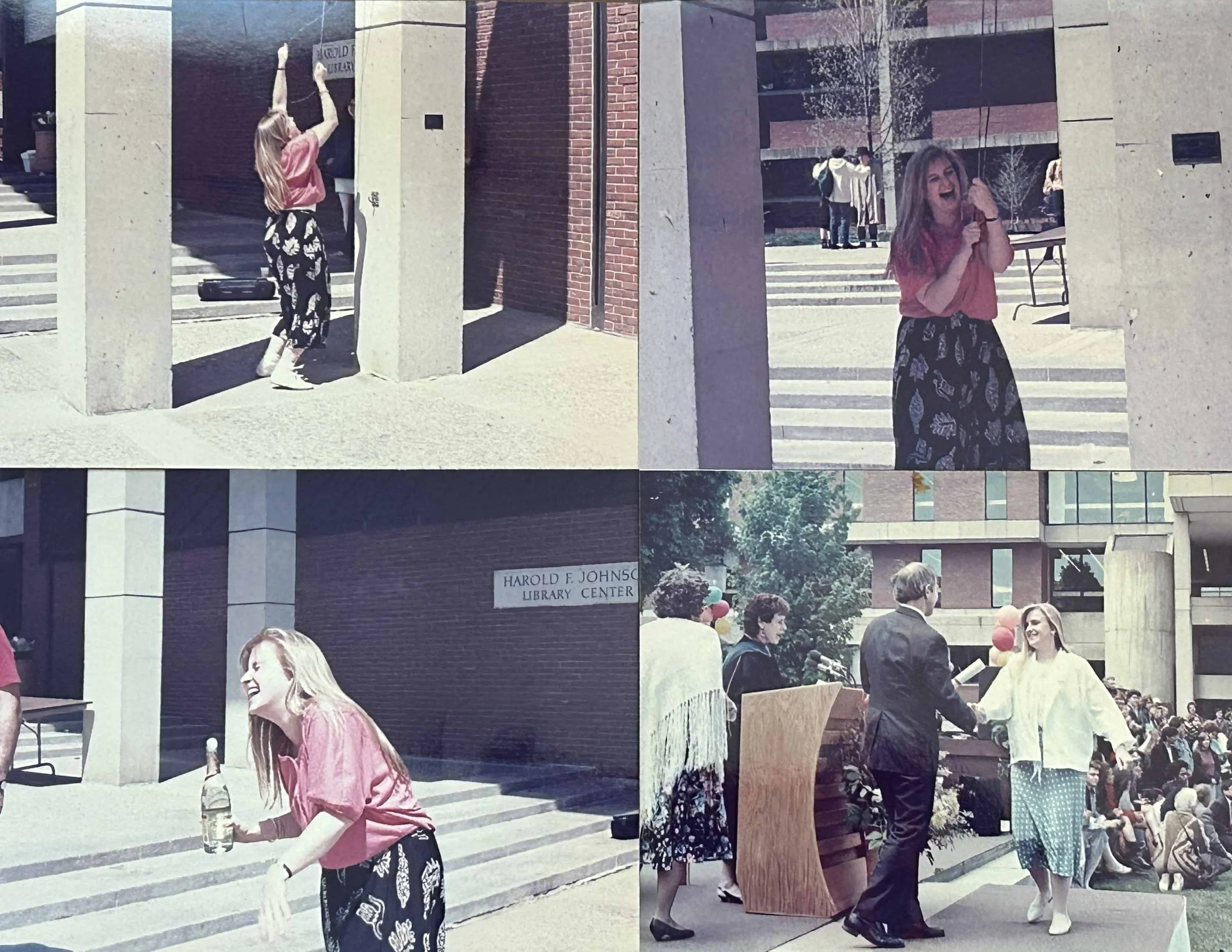
These pictures are of me ringing the bell at Hampshire College, signifying that I passed my Division III (like an undergraduate thesis or capstone), and receiving my diploma. Going to Hampshire was a bold choice for me. It’s not like every other college. I learned how to teach myself there, how to create something from nothing, and how to think outside the box. We almost lost this college. Read on for a story about a college losing track of who they are as a brand, and finding their way back to differentiation.
In the late 1960s, four prestigious institutions — Amherst, Smith, Mount Holyoke, and the University of Massachusetts — set out to test a radical question:
What happens when you remove grades and tests, remove pre-designed majors, and let students build their own education from scratch?
The answer was Hampshire College — a case study in higher education differentiation.
A school intentionally designed to push boundaries.
A place where students didn’t declare majors — they invented them.
A campus built for thinkers, makers, question-askers, and self-directed learners.
It became my alma mater for exactly that reason.
I chose Hampshire because it was wildly, unapologetically different.
One of the most meaningful moments of my education happened at the end: when a student successfully completes and defends their Division III — their self-designed, year‑long capstone project — they earn the right to ring the bell hanging high outside the library. You can hear it across campus. It’s a rite of passage beloved by every alum. A celebration of grit, originality, and self‑directed achievement.
Hampshire taught me how to create my own education, how to teach myself, and how to approach problems from unexpected angles. It trained me to think like an innovator — not a rule follower.
But over time, something happened.
The very differentiators that powered Hampshire’s higher ed branding and set it apart began to fade.
Administrators softened the edges.
Policies shifted closer to the mainstream.
The brand — once fearless — became increasingly familiar.
And the consequences were devastating.
When you dilute your differentiators, you dilute your future.
The Slow Erosion of a Bold Identity
Hampshire’s crisis didn’t come out of nowhere.
It happened the same way it happens in many institutions:
Gradual compromises.
A few policy changes here.
A softened requirement there.
A pull toward “what other colleges are doing.”
Fear of being too different.
Parents often ask:
“Will this help my student get a job?”
“Will grad schools understand this transcript?”
Instead of continuing to educate the market on its value, Hampshire adapted to the market — a common pattern in brand dilution across higher education.
A drift toward the familiar.
The more the school resembled a typical liberal arts college, the more it lost the very students who once sought it out.
And then — the cliff.
By 2019, enrollment had dropped so sharply that Hampshire announced it would enroll only a tiny incoming class. For a moment, it looked like the college might disappear altogether.
That’s the cost of subtracting differentiators: you become invisible.
When a Community Refuses to Let Its Brand Die
But Hampshire’s story doesn’t end there — because its differentiators weren’t just marketing claims. They were woven into the DNA of students, faculty, and alumni.
And when the institution started to lose sight of who it was, the community fought to bring it back.
The turning point came when Hampshire didn’t abandon its identity — it returned to it, stronger than before.
Hampshire did something rare in higher ed:
It doubled down on the very things that once made it unforgettable.
How Hampshire Reclaimed Its Identity (and Rebuilt Its Higher Education Brand)
Here’s what brand resurrection looks like in practice:
1. From Majors to “Urgent Challenges”
Instead of organizing learning around traditional academic departments or preset majors, Hampshire rebuilt its curriculum around the most pressing questions of our time — not just challenges that exist now, but the ones the world hasn’t encountered yet.
Students explore big, unresolved problems and learn how to think in ways that prepare them for a future where the questions — and the answers — haven’t been invented.
Learning Collaboratives now ask:
What problems will the next generation need to solve?
How should humans act in a world reshaped by technology, inequity, and uncertainty?
How do we prepare students to meet challenges no syllabus could predict?
This is education built for what’s next, not what’s comfortable — the foundation of innovative curriculum design in higher ed.
2. The Three-Division System — Sharpened, Not Softened
Hampshire kept and strengthened its pioneering, project‑based model:
Division I: Exploration across disciplines, collaboration, foundational skills.
Division II: A student‑designed concentration built around a guiding question, supported by a faculty committee.
Division III: A year‑long, original capstone project — research, artistic work, scientific development, performance, film, technology — culminating in a formal defense.
And yes — when you pass your Division III?
You ring the bell.
3. Narrative Evaluation — Not Grades
Hampshire still rejects traditional letter grades.
Instead, students receive detailed, narrative evaluations — more like professional performance reviews than report cards.
Students don’t select a major from a list; they build their own concentration with a faculty committee.
Project‑based work, field studies, internships, and original research aren’t add‑ons — they’re core components.
This model produces independent thinkers who can synthesize, create, question, and contribute.
4. Mission-Driven Funding: The Ken Burns Initiative
Famed documentary filmmaker Ken Burns, a Hampshire alum, launched the Ken Burns Initiative to support Hampshire’s renewed commitment to innovation in higher education.
The initiative funds the development and documentation of Hampshire’s reinvented learning model — aiming to share it nationally as a blueprint for how liberal arts colleges can evolve.
When your differentiator is clear, aligned, and lived, people want to invest in it.
The Results: A Brand Reawakening
The enrollment numbers tell the story:
2019: Only 13 new students enrolled.
2021: First-year enrollment doubled.
2022: Largest entering class since 2018.
2024: 844 students total, trending toward a sustainable 1,000.
Hampshire isn’t “back.” It’s a powerful example of how a diluted higher education brand can be rebuilt.
It’s becoming — again.
Because when a brand remembers who it is, people do too.
The Lesson for Every Higher-Ed Institution
Hampshire’s story is more than an anecdote — it’s a higher ed transformation blueprint.
It’s a warning — and a map.
Dilution is death.
When you start removing the things that make you different…
When you try to appeal to everyone…
When you soften your edges to feel safer…
Your identity becomes vague.
Your value becomes harder to articulate.
Your audience drifts.
But clarity is life.
When you name your differentiators…
When you live them boldly…
When your community can feel them everywhere…
You become irresistible to the right students.
A Brand Lives When Its People Believe in It
If Hampshire’s rebound teaches us anything, it’s this:
A brand isn’t saved by administrators.
It’s saved by believers.
Students who wanted something different.
Faculty who wanted to teach differently.
Alumni who wanted their alma mater to remain meaningful.
That kind of belief has power.
The kind that can resurrect a college from the brink.
And today, as Hampshire steps boldly into its next chapter…
It’s ringing the bell again — graduating into its next 50 years.
Before You Go
If you haven't read the first installment in this Higher-Ed Differentiation Series, click here: “Why All Colleges Look the Same — And Why That’s a Problem.”
Ready to Protect — or Reclaim — Your Institutional Identity?
If your college or university is ready to stand out in a landscape where so many schools look the same, BRAND-ification can help you rediscover what makes you unforgettable.
Let’s strengthen your differentiators, rally your community, and build a brand your students — and alumni — can believe in.